
A wee dog’s experience at Mary Potter Hospice has taught him to be a life-saving companion.
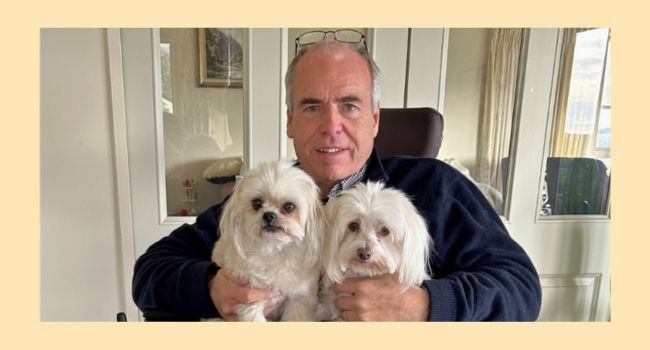
Bryan holds Archie, right, and Mika, left.
Bryan was paralysed from the chest down after an accident six years ago. His wife of 39 years, Denise, died last year at the Hospice.
“They had pushed together three beds, with Denise in the middle and me on one side. Our two dogs, Archie and Mika, were sleeping on her bed too.”
“As Denise died Archie walked up her body… apparently monitoring her temperature and heart rate, then he turned around and walked off and was fine.”
Since then, little Archie the dog has become a life-saving companion to Bryan.
Bryan says that anyone in a wheelchair knows the term autonomic dysreflexia, where the body has a sudden increase in blood pressure, heart rate and temperature in response to stimuli such as pain or other discomfort below the level of the injury. It’s potentially very dangerous.
Some dogs can be trained to detect it, but Archie seemed to pick it up in that moment at the Hospice with Denise.
“Archie never used to sleep on my bed but he does now. If it happens when I’m asleep he’ll stand on my chest, puts his nose in my mouth and wakes me up. That has been so comforting.”
He also used to look out for Denise’s car after work, but since their time at the Hospice he hasn’t done that.
A different experience of hospice care
Bryan said the short time they had at Mary Potter Hospice in Newtown couldn’t be faulted.
“The room was huge and opened on to a garden and a children’s play area. The dogs could wander around, the grandkids were playing outside and Denise could watch them.”
“The whole experience was so different to what the word ‘hospice’ conjured up for me. I didn’t realise it was like that.”
One nurse explained what would happen and how the family might feel, helping them understand what they were seeing and experiencing.
“She seemed to be there all the time. She kept popping in, and other people kept bringing things for us.”
Life after loss
Denise and Bryan moved to New Zealand 26 years ago from the UK. Denise had been a nurse and worked at Health for Life at Coastlands. She was an avid collector of expensive and beautiful things, such as watches, bags, shoes and clothing.
Bryan continues to run a business that sells automotive software and high-end vehicle workshop and repair equipment.
“I was very keen to get back to work after I returned home from Burwood Spinal Unit.”
“You can sit there licking your wounds for a while, but then you realise it’s down to you to do something about it.”
Bryan says returning to work helped him focus on what he could do, rather than what he had lost.